

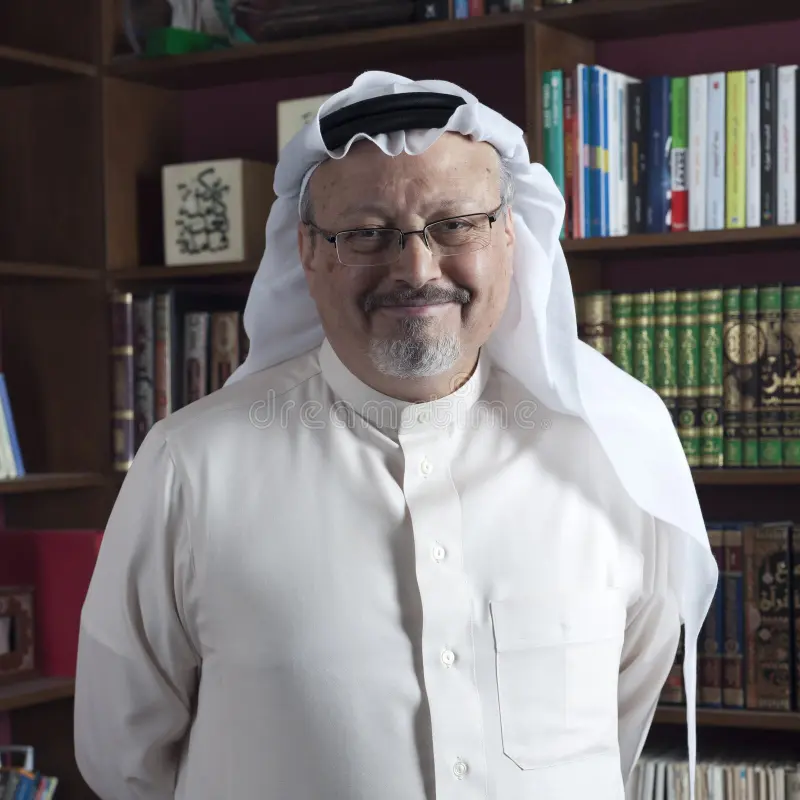
 He walked like a man who knew both sides of power. Jamal Khashoggi, that elegant spokesman of democracy clad in Arab robes, became a symbol of the struggle for free speech in the Western imagination. Brutally murdered, vanished without a trace in the Saudi consulate in Istanbul, his body dissolved in acid, his voice silenced, but the echo remained. That’s the story as we know it. But is it the whole truth?
Beneath the layers of international politics and media romance creeps another shadow – that Jamal Khashoggi may not have been merely a victim of authoritarian crackdown, but also a player in a more complex game, where freedom of speech is a mask and the real prize is global economic influence. A former insider to the Saudi elite, advisor at various points to kings and princes, he knew not only the internal code of Riyadh’s power, but also the mechanisms by which the global scene is shaped around oil, arms, and influence.
In his final years, as a columnist for the Washington Post, Khashoggi wrote critical analyses of Saudi leadership. Yet in his texts, there was a peculiar one-sidedness – a rhetoric that perfectly aligned with certain Western geopolitical agendas. The freedom he fought for often pointed toward regimes like Russia, Iran, or Saudi Arabia – but rarely against the transnational financial structures that support or dismantle those regimes when needed. Khashoggi seemed to believe that democracy was not just a value, but a tool.
Suspicions linger that behind the noble pen, interests stood that transcended his biography. He was a regular guest at international conferences, linked to liberal think tanks and NGOs that have long promoted a globalist vision – one where state sovereignty bows to corporate governance. Some investigative journalists, cautiously, hinted that Khashoggi may have had ties with regional figures working not so much for reform, but for a strategic reshuffling of economic corridors – from Syria, through Qatar, to Turkey.
After his death, the world was outraged. Media made him a martyr. Western elites, a symbol. But as often happens, the greatest heroes are born in moments when the image is more useful than the truth. And if the truth about Khashoggi never fully comes to light, one lingering feeling remains – that behind the tears of his fiancée and the pathos of editorials lies a deeper war. Not between dictatorship and democracy, but between global elites using journalists not for their words, but for their effect.
He knew too much. Perhaps too much. Maybe that’s why he died.
In geopolitics, as in the ocean, there is no such thing as innocence. Ideologies are merely the delicate skin over the flesh of predators — camouflage for those who justify hunger with principle. People often confuse the fight for freedom with the hunger for dominance. When someone begins to criticize kings and his words start circulating through editorial rooms in Washington and London, he is no longer just a journalist — he is a player. And in this game, there are no referees — only predators with better camouflage.
Jamal Khashoggi’s story is not a fairytale of a good man silenced by an evil empire. It is a lesson in realpolitik: those who decide to swim among sharks must learn how to move like one. If you set out to become a shark without the hunger of one, they will smell your weakness. And they will devour you — not because you are evil, but because you are edible.